





ABS WARNING LIGHT SERVICE
ABS Warning Light Service
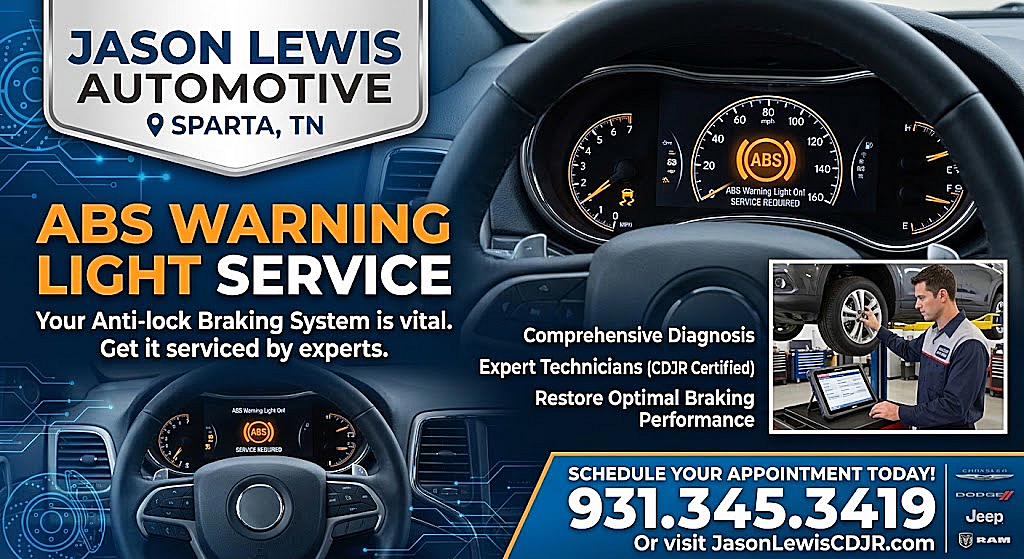
Is Your ABS Warning Light On?
Don't Ignore One of Your Vehicle's Most Important Safety Systems
Your vehicle's Anti-Lock Braking System (ABS) is designed to help maintain steering control during emergency braking situations. If the ABS warning light appears on your dashboard, your vehicle may still stop normally, but an important safety system may not be functioning as designed.
Whether you drive a Ram truck, Chrysler 300, Jeep SUV, or any other vehicle, a professional inspection can identify the cause of the warning light and help restore proper operation.
What Does ABS Mean?
ABS stands for Anti-Lock Braking System. The system helps prevent wheel lockup during hard braking situations.
Without ABS
- Wheels may lock
- Tires can skid
- Steering control can be reduced
- Vehicle stability can be affected
With ABS
- Wheels continue rotating
- Tire traction is better maintained
- Drivers can continue steering while braking
- Vehicle control is improved during emergency stops
The purpose of ABS is not necessarily to stop the vehicle faster. Its primary purpose is to help the driver maintain control.
Emergency Braking Example
Without ABS
- Driver applies brakes hard
- Wheels lock
- Vehicle skids
- Steering control reduced
With ABS
- Driver applies brakes hard
- ABS rapidly adjusts brake pressure
- Wheels continue rotating
- Vehicle remains steerable
- Driver maintains greater control
Did You Know?
If you feel pulsation or vibration in the brake pedal during an emergency stop, ABS may be functioning normally.
Many drivers mistake this sensation for a mechanical problem when it is actually the system actively preventing wheel lockup.
Why ABS Matters in East Tennessee
Most East Tennessee drivers don't deal with months of snow like northern states. However, the weather conditions we do experience can create serious driving challenges. These conditions include:
These road conditions can dramatically reduce available traction.
How ABS Helps During Snow And Sleet
Imagine you're traveling down the road during a winter weather event and traffic suddenly slows ahead. Your instinct is to brake quickly.
Without ABS
- Wheels may lock
- The vehicle may slide
- Steering control may be reduced
With ABS
- Brake pressure is rapidly adjusted
- Wheels continue rotating
- Tire grip is maintained more effectively
- The driver can continue steering
ABS helps provide additional control during slippery conditions commonly encountered throughout East Tennessee.
East Tennessee Drivers Face Unique Challenges
Road conditions can change quickly. Roads may be:
- Wet in the morning
- Frozen in shaded areas
- Dry by afternoon
- Covered in sleet after sunset
These rapidly changing conditions create situations where ABS can become extremely important.
Did You Know?
Black ice is often nearly invisible. During hard braking on icy surfaces, ABS helps reduce wheel lockup and may allow drivers to maintain steering control during an emergency.
Is It Safe To Drive With The ABS Light On?
This is usually the first question drivers ask.
The Short Answer
Possibly, but it should not be ignored. While your vehicle may appear to drive normally, one of its advanced safety systems may no longer be available when you need it most.
Warning
If both the Brake Warning Light and ABS Warning Light are illuminated, schedule service immediately.
This could indicate a more serious braking system concern.
In many situations:
- Normal braking continues to function
- ABS functionality may be disabled
- Traction control may be affected
- Stability control systems may be affected
Why Did My ABS Warning Light Come On?
Several components work together to operate the ABS system. The warning light illuminates when the vehicle detects a fault.
Common Causes
| Possible Cause | What It Means |
|---|---|
| Wheel Speed Sensor Failure | System cannot accurately monitor wheel speed |
| Sensor Wiring Damage | Electrical communication problem |
| Low Brake Fluid | May affect brake system operation |
| ABS Control Module Fault | Electronic control issue |
| Hydraulic Control Unit Problem | Pressure regulation concern |
| Wheel Bearing Issue | Can affect sensor readings |
| Electrical System Problem | Voltage or communication issue |
What Are Wheel Speed Sensors?
Wheel speed sensors are one of the most common causes of ABS warning lights. These sensors monitor the speed of each wheel hundreds of times every second. The ABS system uses this information to determine when a wheel may be about to lock up.
If the system cannot receive accurate information from a sensor, the warning light may illuminate.
Did You Know?
Many ABS warning light diagnoses ultimately lead to a wheel speed sensor or wiring concern rather than a major brake component failure.
That's one reason professional diagnosis is so important.
What Happens During ABS Diagnosis?
The warning light itself only tells us that the system detected a problem. The next step is determining exactly what caused it.
The goal is to identify the root cause of the issue rather than simply replacing parts.
Our ABS diagnostic process may include:
- Retrieving ABS fault codes
- Scanning vehicle modules
- Testing wheel speed sensors
- Inspecting sensor wiring
- Evaluating brake fluid condition
- Inspecting ABS module operation
- Checking related braking components
- Verifying system communication
How Long Does ABS Diagnosis Take?
One of the most common customer questions is: "How long will it take?"
| Service | Typical Time |
|---|---|
| ABS System Scan | 30-60 Minutes |
| ABS Diagnostic Inspection | 1-2 Hours |
| Advanced Electrical Diagnosis | Varies |
Repair time depends on the cause of the problem and the components involved.
ABS vs. Standard Braking System
Many drivers assume their brakes have completely failed when the ABS light appears. Fortunately, that's often not the case.
| Standard Brakes | ABS System |
|---|---|
| Stops the vehicle | Helps prevent wheel lockup |
| Used every time you brake | Most active during hard braking |
| Uses pads, rotors, and hydraulics | Uses sensors, computers, and hydraulics |
| Provides stopping power | Helps maintain control during emergency braking |
Important
A vehicle can often stop normally even when the ABS warning light is illuminated. However, one of its most important safety systems may not be available in an emergency situation.
When Should You Schedule Service?
Prompt diagnosis can help restore proper system operation and prevent additional issues.
Schedule ABS diagnosis if:
- The ABS warning light remains on
- The ABS light turns on repeatedly
- ABS and traction control lights appear together
- ABS and brake warning lights appear together
- You notice unusual braking behavior
- Dashboard warning messages appear
Frequently Asked Questions
(Click + for the answer)
ABS stands for Anti-Lock Braking System.
In many cases, standard braking remains functional, but the ABS system may not be available during emergency braking situations.
Common causes include wheel speed sensor failures, damaged wiring, low brake fluid, module faults, and hydraulic control issues.
Many drivers notice rapid pedal pulsation or vibration. This is often normal ABS operation.
If the issue remains present, the warning light will generally stay illuminated until the problem has been diagnosed and corrected.
Schedule Your ABS Warning Light Inspection Today
Your Anti-Lock Braking System is designed to help you maintain control during emergency braking situations, especially during snow, sleet, wet roads, and changing weather conditions common throughout East Tennessee.
If your ABS warning light is illuminated, don't ignore it and don't guess at the cause.
Schedule a professional diagnosis and gain confidence that your vehicle's braking system is ready when you need it most.